
High Performance Organizations Aspire
HPO ASPIRE
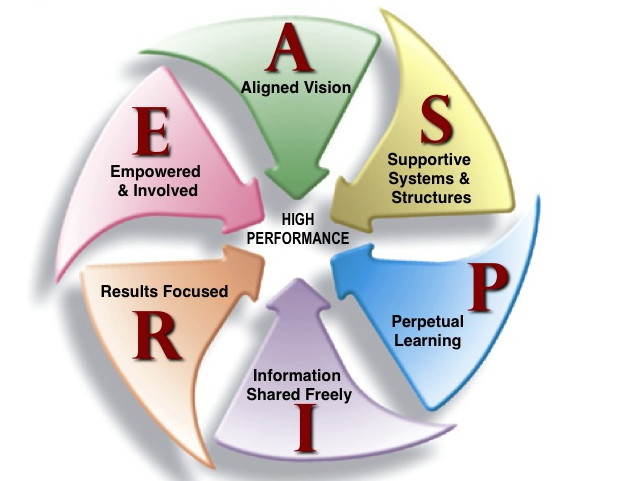
High performance organizations aspire to greatness. Our research revealed six characteristics of high performing organizations – organizations that sustained high levels of productivity, profitability and employee satisfaction over time. The HPO ASPIRE model depicts these traits.
 Aligned around a shared vision
Having a clear vision, that illuminates a compelling purpose and core values and which is understood and passionately supported by all, creates a strong, focused culture that drives the desired business results
In high performance organizations, affirming the purpose and values and reviewing the vision is an ongoing process. People think strategically as they make decisions, are flexible in response to challenges, appreciate diversity and creativity, and there is a higher level of trust because they know they share the same vision and values.
Conversely, when an organization does not live up to its stated values, employee and customer trust and commitment erode, impacting the bottom line.
 Supportive systems and structures
Systems, work processes structures and practices that support achieving the vision and goals of the organization make it easier for people to accomplish their work and allow the organization to be nimble and responsiveness to changing needs.
In many ordinary organizations, the systems and structures often derail people. Policies and procedures make getting the job done harder instead of easier. An individual’s purpose may be aligned with the purpose of the organization, but the systems or structure steer them in the wrong direction.
However, in high performance organizations, systems and structures are supportive. For example, when the organization had a vision that involved teamwork, it had also developed systems that rewarded people for team accomplishments and trained people in effective team skills.
 Perpetual learning
Organizational learning is different from, yet interdependent with, individual learning. High performance organizations account for both.
Building organizational knowledge and capabilities includes not only acquiring information but also learning from it and applying it to new situations. Barriers to performance occur when knowledge is not shared. This is one of the reasons cross-functional collaboration is so important and was always present in the high performance organizations we studied.
Knowledge exists in the minds of knowledgeable people. Unless the individual learns, the organization cannot learn. Therefore, development of people is an essential part of the organizational culture and is seen as an investment in building the knowledge capital of the organization.
 Information freely shared
There is a broad definition of what is relevant and necessary information. Information needed to make informed decisions is readily available to employees and is shared in multiple directions. Leaders get out into the organization to share and to listen. And they encourage the active exchange of information among teams, departments, units and individuals.
They share information with employees that some organizations reserve only for the top of the hierarchy, such as future business plans and strategies, financial data, and company and industry issues.
High performance organizations regularly solicit and distribute customer and market feedback, which allows for quick responses and corrections and enhances their ability to adapt to changing environments and demands.
 Results focused
There is an almost obsessive focus on results in high performance organizations. However, they uniquely focus on results from the perspective of their customer.
Processes are designed from the customer experience backward, which ensures a flow that makes sense from the customer’s perspective and makes it easy for customers to do business with them.
New products and services are developed in anticipation of trends and customer needs. Internal cross-functional relationships and structures are organized around customer needs. Measures focus on the customer experience. Accountability is to the customer.
 Empowered and involved
Power and decision-making are shared and distributed throughout the organization and not guarded at the top of the hierarchy. Participation, collaboration, and teamwork are a way of life. They operate from the premise that when people are clear about goals and standards and have clear boundaries of autonomy, they are better able to accomplish results.
Employees are empowered to take risks, be innovative, respond to the customer and make decisions. Involvement in decision-making by the front line who are close to the customer enhances the quality of decisions, and employees view themselves as valuable contributors. Employees experience a strong sense of individual and collective power.
*The HPO ASPIRE model is derived from a three-year research study conducted by Dr. Don Carew, Dr. Fred Finch, Dr. Fay Kandarian, Dr. Eunice Parisi-Carew and Dr. Jesse Stoner, which included a meta-analysis of studies over a twenty-year period as well as conducting a comprehensive assessment of over a thousand workers in a variety of organizations that validated these categories. For more information on this study, see my earlier post “Four Views in High Performance Organizations.”





Jesse, From my perspective working in a nonprofit, your aspire model really works. However, I’ve just finished the biography of Steve Jobs, and found that his leadership style really contrasted with what I thought would work. The two things that he really agreed with you on were being aligned around a common vision and being results focused from the perspective of the customer. However, I’m not sure that supportive system or empowerment were strong values. Have any of your readers worked for Apple? What was their experience?
Hi Betsy, You raise an interesting question. Is Apple an organization that sustains both outstanding results and the highest levels of human satisfaction over time? I suspect Steve Job’s charismatic and strong personality and personal genius was the glue that drove Apple and I’m not entirely sure about the culture. Time will tell. We often hear about amazing companies like this but they are the exception, not the rule, and results are usually not sustained beyond the tenure of that leader. We need more time to find out the full story of what Apple has been and will be. When Louis Gerstner Jr. took the helm of IBM in 1993 and made the famous statement, “the last thing IBM needs is a vision,” people asked me what I thought. I said, “It depends on how he defines vision.” Two years later he announced a vision for IBM that turned the company around. My own opinion is it’s too early to judge what has made Apple so successful. But I would love to hear what others think.
What a terrific model. I always love a good acronym… especially when it’s so spot on. You always provide so much food for thought. Thank you!
Hi Julie, Glad you like the model and acronym. Acronyms are helpful when you already know the concepts and then find a creative word that expresses it. Unfortunately too many times people go at is the other way around, choosing a clever word and then creating a model to fit it, and end up with sloppy content. In this case, our 6 factors emerged from research. The challenge was to find an acronym that expressed them. I was delighted to find that ASPIRE worked.
Awesome model Jesse! I’m thinking this could also work as a model for a healthy community by changing the Aligned Vision to be about aligned visions rather than one shared vision and the “R” to Relationship Focused. I’m finding that organizational models only work so well when applied to place based communities. Wheatley and Block both have great lessons about supporting community but both writers ideas are hard to share – “just read the book” – doesn’t quite cut it lol
Hi Jamie, As always, I appreciate your creative thinking and your energy around the model. You raise an excellent question about how it could be applied to communities. I think the model does apply in its current form, and I am reluctant to change the model because it is research-based. The study was quite rich and produced two lengthy white papers, an article and a psychometrically sound assessment. In this blog post, I only gave a brief overview of each category. To apply to communities, I’d suggest you could just take the description up one notch. Communities do need an aligned vision, agreement on what a healthy community looks like, in order to integrate the various programs. When we talk about “Results-focused” in business, we use the language “customer-centered results.” However in NPOs and communities, constituency could be substituted for the term customer, in this case the members of the communities. In our research, healthy relationships did not show up as a distinct category, however instead was embedded in (V) vision, (I) information and communication (including dialogue) and (E) shared power and high involvement. I really appreciate your looking at other applications of the model. I agree, we need to find ways of translating complex concepts described in books without diluting them so much they are meaningless.
Love the points you bring out Jesse and it’s even more flattering that it rings out to ASPIRE from an acronym perspective. I will be definitely adopting thse lessons as we build the team?
Thank you, Thabo. Glad it’s useful.
Thanks again, food for thought that resulted in a new post for me 🙂
I really like this though many i would interact with in healthcare would either find the acronym wearisome or feel they were too busy with the day job to take even a simple and powerful meta-view of this sort. Whether I can sell this over other frameworks is hard to know for sure but its a great basis for discussion and it certainly captures what we are working on in my organisation.
I jokingly wondered if it should really be PASPIRE, less to make a pun on the hard work involved in leading organisations but more because I’m convinced that an second “P”, psychological awareness, is a neglected critical factor in organisational health and performance….I can see this could woven into several of the ASPIRE domains but my concern is that it is so taken for granted that many problems are perpetuated and generated without leadership in the organisation even being conscious of what is happening. It would be interesting to know if elements of this, eg emotional intelligence, relexivity, and the insights that can come from systemic and psychodynamic approaches to organisational functioning, were overtly tested in the research studies? Or were they, just as they so much are in the organisation themselves, “beneath the surface” (useful book edited by Huffington et al) and so not articulated in the study design.
Thanks for a stimulating framework….will ponder more!
Hi Tony, Glad you found the framework interesting. I always feel my blog has been successful if it leaves one pondering. I understand your concerns about the acronym. Acronyms are helpful as a nemonic device, but can seem too “cutesy” to some. The elements themselves were revealed through statistical analysis. Naming them so they created an acronym was a creative challenge. Because identification of the elements was the result of a meta-analysis of over 60 studies and two years of research subjected to rigorous psychometric analysis, the elements are statistically sound, and adding any additional ones would invalidate the findings. The only latitude was in naming them. Psychological awareness is an important leadership trait, however, this model is not looking at individual behavior but at organizational behavior. We did discover 4 themes that emerged as underpinnings, which I described in Four Views in High Performance Organizations, but these were attitudes and not traits. As to your question about what might not have been revealed because the right questions were not asked, that is always an issue in research, and is what makes models only an approximation of reality. Models are an attempt to organize reality so that it can be discussed. Truth is always more complex.
Hi
It’s really amaizing and very interested for me .
Thank you Jesse,
BR,
Salem,
Thanks, Salem. Glad you found it interesting.
Jesse
Clear, concise, stands the test of time!